

St John Ambulance are proud to announce that we have released our own-brand defibrillator to help save lives across the country. As part of the launch, a competition was held to name the new life-saving product. The winning entry came from Robin, a Badger from the South-East Hampshire Network, who was selected as the overall winner.
Available to purchase today, our defibrillator boasts a powerful name that nods to our cultural HEART values. These values run through the centre of everything we do at St John Ambulance:
- Humanity
- Excellence
- Accountability
- Responsiveness
- Teamwork
St John Ambulance is proud to offer two automated external defibrillators in our lineup: the HEART One and HEART Two. These devices are cutting-edge AEDs that combine compactness, robustness, reliability and affordability. They were developed in partnership with an innovative manufacturer with a clear mission – to make AEDs more accessible to everyone by improving technology and reducing cost.
Both HEART One and HEART Two are compact and lightweight (1.5 kg including the battery and pads) and are designed to be used by anyone in an emergency. Despite their small size, these AEDs are packed with smart features. They perform daily self-checks to ensure readiness, have clear voice prompts (and visual prompts, as you’ll see), and come with a long 8-year warranty for peace of mind.
The name “HEART One” and “HEART Two” reflects that they are part of the same family – sharing the same core technology – with HEART Two having a couple of extra features such as a display screen and other features that you can explore with our handy guide below.
To learn more about our own-brand defibrillator models, click here.
HEART One – Key Features Guide
The HEART One is our flagship easy-to-use AED model. It’s a semi-automatic defibrillator designed with simplicity in mind, ideal for places such as offices, schools and community centres.
- Easy registration using smartphone, simply scan the QR code and register.
- Straight-forward operation: Just press the green power button to turn it on, and the device immediately starts giving voice instructions.
- Effective shocks & guidance: Using a modern shock waveform, which is proven effective for defibrillation as well as CPR guidance for chest compressions
- Use on both adults and children with no need to switch pads
- Lightweight and portable defibrillator
- High-capacity long-life lithium battery
- Rugged, reliable and drop-tested for durability
HEART Two – Key Features Guide
The HEART Two AED has all the capabilities of the HEART One, with a few additional features. The HEART Two is ideal for environments where you might benefit from visual prompts - for instance, in noisy areas to assist hearing impaired users or in settings with multilingual users or large volumes of visitors.
- 5-inch LCD screen: A bright addition to the Heart model that displays animations that compliment voice controls
- Multi-language support with up to 3 languages
- Same compact design, lightweight and portable
- Shared pads and battery
- Data & connectivity ready: HEART Two has a USB port and Bluetooth capability
What is a Defibrillator?
A defibrillator is a lifesaving medical device designed to help someone experiencing sudden cardiac arrest—a condition where the heart suddenly stops beating effectively. When this happens, every second counts. A defibrillator works by delivering a controlled electric shock to the heart, with the goal of restoring a normal rhythm.

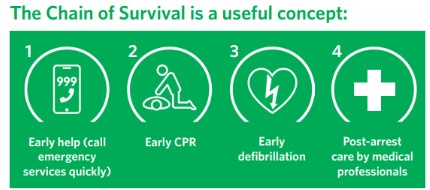
If you have completed any comprehensive First Aid at Work training, you should be properly educated on how to quickly and effectively use a defibrillator. When someone experiences sudden cardiac arrest, using a defibrillator early, ideally within the first few minutes, can make a critical difference in survival. With the aim of quickly restoring a heartbeat, a defibrillator can dramatically increase a person’s chance of survival until emergency medical help arrives. The defibrillator works as part of the “chain of survival” circuit, which includes calling emergency services, starting CPR, using a defibrillator, and getting advanced medical care.
How Do Defibrillators Make a Difference?
Statistics show that when a defibrillator is used within the first 3–5 minutes of collapse, survival rates can jump to as high as 70%, compared to less than 10% without early intervention. By delivering a shock that can restart the heart’s rhythm and buying time for paramedics to arrive, defibrillators are a vital part of lifesaving first aid.
The genetic and demographic diversity within any workplace highlights the importance of having a defibrillator readily available. With a wide range of risk factors linked to varying lifestyles, family histories, and health profiles, it's wise to take a precautionary approach when it comes to cardiac arrest. Every individual brings a unique set of characteristics that can influence their risk, making preparedness essential for ensuring a safe work environment. Register your defibrillator on The Circuit – a network designed to put more essential tools into the hands of more people and learn more about how defibrillators can truly save a life in your workplace with real life stories.
At St John Ambulance, as well as releasing our new own-brand defibrillator, we regularly have offers on our range of defibrillators, which you can browse here.


